Sunday, November 27, 2016
Mary - A Poem
Dark braids
Dangling
Down
Your
Back,
Close to
Patches sewn on
Your garment for
More use.
Dough lining
Your fingers
While the
Bread of Life
Grows within.
Thoughts about dinner
And checking on sheep,
When the visitor came
With astonishing news.
"A baby for me,
From God did you say?
I'm not ready to be
A mother.
Let
Me
Think."
"God is with you,"
The angel said.
"All is well.
Let it be.
I'll finish the bread,
Gather figs for dinner,
Check on the sheep
In the pasture,
And visit Joseph in
His shop.
Oh my!"
Sunday, November 20, 2016
Sunday, November 13, 2016
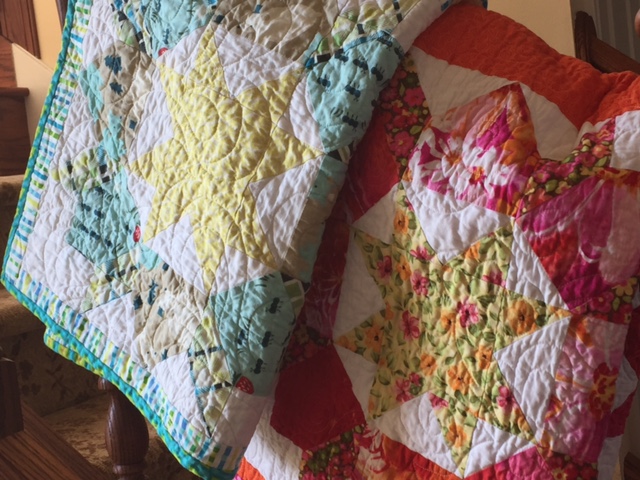
Memory Quilts for Sean and Jillian
I first met my dear friend, Selena, on a windy, chilly, snowy
day, a week before Christmas in 2010. She and her husband, Jeff, along with members
of their extended families were standing on snow covered, icy ground near the
front of a small, rural cemetery.
When I got out of my car, my eyes went quickly to the tiny,
grey casket perched on a wooden bier in front of a large whole dug in the
earth. I’d never attended an infant funeral.
Mike, stood next to Selena and Jeff, although I could easily
have picked them out in a crowd with grief molding their faces and eyes that
were blank allowing tears not vision to settle in and flow.
I stood to the side to let the family have full view so they
could hear the prayers and words Mike would say to commit two, sweet little
souls to God and their bodies to the earth. The twins, born at 23 weeks,
survived a few days; Sean, the little boy, one day, his sister, Jillian, two.
Jeff and Selena scheduled to relocate from Raleigh, North
Carolina to Fishers, with Jeff’s job transfer, birthed the babies, and packed
to move following their loss, all within a month.
They knew no one in Fishers. However, God set to work an
amazing series of events to bring them to a church that would envelop them with
love and compassion for these days. Their pastor in Raleigh, knew Mike from their days at the Duke Divinity
School. He contacted Mike, describing Sean and Jillian’s deaths. Mike set in
motion through a series of emails and phone calls a few nights of meals, visits
from people in the church to assist with the early days of their arrival and
following the funeral service.
Even the caretaker of the small cemetery was a member of the
church. She quickly arranged a place for the children to be buried.
With such deep grief and knowing few people, Selena turned
to her long-time skill in quilting to companion her through these days and
months of processing great loss.
She and Jeff were given all of the quilts that touched Sean
and Jillian while they were in the hospital. Early in February, Selena decided
to make two memory quilts, one for Sean and one for Jillian to send to the
hospital in Raleigh where they were born.
With her then nearly three-year-old son, Alex, by her side, they
found quilt shops in the Indianapolis area. Eventually she found the perfect
fabric to honor her dear children. Planning the quilts, and purchasing fabric,
gave Selena structure and focus for her days.
Into the spring and summer she sewed and quilted, finally
finishing in mid-fall, ready to mail to Raleigh in time for the first
anniversary of their deaths, November 18. Before she packed the quilts, she
asked the two pastors of the church, her Bible study group and a few friends,
to pray over her handwork. The quilts were heavy with her grief, but also heavy
with prayer from those who cared and loved her.
I asked Selena to describe her experience making the memory
quilts.
“The hum of my sewing machine has always brought me a sense
of peace. As a young girl, I’d play with my dolls at my mother’s feet under the
table while she sewed, hearing the monotonous hum of the needle piercing the
fabric.
I grew up and discovered my love for sewing in particular
making beautiful quilts. Six years ago, my husband and I lost our beloved son
and daughter. At a time when I didn’t want to get out of bed in the mornings, I
knew I needed to honor them by living.
The hum of the machine once again brought me peace. At the
hospital in Raleigh, we were given everything our children touched, including
quilts, blankets and hats. I found comfort in these items because I was
touching what they had last touched.
I decided to start making memory quilts in their honor to
give the feeling of touch and warmth to other families. While I piece together
bright, happy fabrics (because I know the personalities of my children are
bright and happy in Heaven), I pray for each of them. I also pray for the baby
girl who will receive my daughter’s memory quilt and the baby boy who will
receive my son’s memory quilt, praying deep into the threads, breathing prayers
into the batting, lovingly holding the fabrics as I lovingly held my own son
and daughter.
I have made two quilts each year since their passing. I send
them to the nurse who cared for my children six years ago. She, along with the
staff, decide which family will receive the quilts each year. I know my
children are resting in the arms of the Lord, proud of what their mother is
doing, listening to the peaceful hum of the sewing machine."
For Your Reflection:
1.
How have you worked through times of deep grief
and loss? 2. What ways help you touch those places of grief that seem endless, without words or form?
3. Can art (I consider quilting an art form) become an avenue of expression, a picture of what wells from your heart?
Join me in praying for Jeff and Selena this week as they remember the sixth anniversary of the loss of Sean and Jillian this Friday, November 18.
Prayer: God, many times we plough through unbearable grief, similar to Selena and Jeff. Our loss may have a different nature, but deep grief is often without form. Thank you for Selena’s gift of sewing that allows her to companion others who are going through similar experiences. May you bless each with love, and prayers that are within every stitch and inch of fabric. Guide those who are in grief; lead them to a way through a hobby or special interest that their grief can come to a place of peace, glorifying you with gratitude. Amen.
Sunday, November 6, 2016
Sunday, October 30, 2016
Earth"s Quilt - A Poem
Time to make the earth's quilt.
Yellow, orange and red leaves
Come together in random patterns,
Warming the earth
Through winter's cold,
Covering seeds that rest,
Waiting for the time to
Burst forth with pastel colors --
A sweet sight after winter's grays.
Rest, earth, rest under the quilt
You provide for yourself.
Sunday, October 23, 2016
Jesus Wrote and The Loss of the Contemplative Mind
Jesus preached, blessed, ate, healed, walked, talked and ..........wrote!
John Chapter 8-1-11 described an encounter Jesus had with teachers of the law and Pharisees who asked about a woman caught in adultery. The punishment according to Jewish law was stoning. Before he responded, Jesus took a moment to write in the sand. Verse 6: "But he (Jesus) bent over and wrote on the ground with his finger."
Jesus knew the importance of his answer, so he took a moment to pause and write.
"As they stood there asking him questions, he straightened up and said to them, "Whichever one of you has committed no sin may throw the first stone at her." (verse 7)
After he answers the teachers and Pharisees, he bends over again to write on the ground.
We don't know what Jesus wrote, but he did give an example to pause and reflect before answering.
The End of Reflection
On Sunday, June 12, The New York Times, featured an article by Teddy Wayne called "The End of Reflection." The author recognized a change in his life. In the past when he had extra time, he would "observe or think about my surroundings or take a walk."
Now he notes, "I pick up my phone to check a notification, browse and read the internet, text, use an app or listen to audio or on rare occasions, engage in an old-fashioned "telephone call." The last remaining place I'm guaranteed alone with my thoughts is in the shower."
Wayne quotes Nicholas Carr, author of The Shallows. "As our technologies increase the intensity of stimulation and the flow of new things, we adapt to that pace. We become less patient. When moments without stimulation arise, we start to feel panicked and don't know what to do with them, because we've trained ourselves to expect this stimulation."
Carr sees the use of the internet and other electronics as "the loss of the contemplative mind."
We need a contemplative mind to stay in touch with God. If we go with the trends Wayne and Carr are noting in their articles and books, we are doomed to shallow thinking and impatient attitudes.
The January, 2016, issue of the American Association of Retired Persons (AARP) included a short article, "The Write Way to Slow Down." The article explains, "One thing proven to help you slow down is writing your thoughts and feelings longhand. On paper. It's not just writing; it's taking time to think and process life events. The ritual is an effective way for you to analyze situations creatively and to stay centered during difficult times."
There it is. Writing. The way to slow down.
Jesus modeled it well for us, and John captured the moment when Jesus wrote in the sand.
Returning to Jesus
Jesus knew the Pharisees and teachers of the law were waiting for an answer. Jesus realized the importance of the question required careful thought so he paused, twice to write on the ground.
They were expecting consent to the Jewish law, so Jesus' answer stunned them when he offered compassion and forgiveness.
Of course, no one knows what Jesus wrote before or after he responded or if he wrote something to the woman, to those asking the question, or to God. Perhaps he wrote a prayer asking for wisdom prior to his answer and a prayer of gratitude afterwards. No one knows.
Jesus offers a model to use not only when we are involved in thought-provoking or difficult conversations or responding to a question with a friend at work, at church or other places.
1. Take a moment to pause before replying. Collecting thoughts and organizing how to phrase an answer can result in an effective and meaningful response and encourages a contemplative mind.
2. Offer a quick prayer for guidance.
3. Write down a few thoughts - after all, the article in AARP reminds us that writing slows us down.
4. Say a short prayer of gratitude for God's help after replying.
Slowing down in today's fast-paced world is a challenge, but necessary. Companionship with God demands times of silence, contemplation and reflection to grow deeper in faith and hear God's voice.
For your reflection:
1. What do you think Jesus wrote in the sand?
2. How can you incorporate Jesus's model of writing before replying into everyday life.
3. What is the value of writing for you?
Prayer: God, advances in communication seem to discourage the contemplative mind. How can we weigh seriously and listen to your voice as we talk with others and consider matters of importance? Help us use Jesus' model of pausing and writing in our interaction and during our time with you. Amen.
Sunday, October 16, 2016
Found Objects - What I Found - What Jesus Found
The book How To Be An Explorer of the World led me to start with the activity suggested on page 30—to collect items on a walk. The first few times I went around the neighborhood, all I found was a leaf and an empty acorn shell. I live in a housing addition that is well-kept with little trash.
A few days later I found several note-worthy items that I stuffed into my pocket. When I arrived home, I examined the ‘gems’ – a yellow candy wrapper, a red bottle cap, a rusty ‘S’-shaped chain, a rubber band and a wrapper from Walgreen’s for adhesive bandages.
I added to my collection a note I found in the locker to which I was assigned at the Jordan Y, and a listing of Christmas hymns on a piece of paper I found in a library book. On the back side of the paper were the dates for Advent, beginning in late November.
All of a sudden the box that held my finds was filled with items that offered more questions than the leaf and acorns. I knew where these two came from, but everything else tapped my inquisitive imagination. For example, when I looked at the candy wrapper, I wondered what type of sweet the paper held. How did it taste – sweet or sour? Who ate the candy? When and where was it purchased?
The listing of Christmas carols on the slip of paper from the library book as well as the dates for Advent made me wonder if the person who wrote this information was a church choir director or a pastor. I could contact him, as his name is printed on the front, but I like letting my imagination wonder what the dates and hymns mean.
I wondered what liquid the bottle cap topped and who drank it. Why did someone need an adhesive wrap? Who wore the wrap – a child or an adult?
All of this reflection made me remember how Jesus used common objects to tell stories and teach.
How Jesus Used Common Objects
Jesus taught using parables or stories using metaphors – a comparison to something in the kingdom using like or as: The kingdom of heaven is like a pearl, or the kingdom of heaven is like yeast.
Perhaps over a series of days Jesus collected a few objects that he saw in the homes where he stayed or along the path he walked. He decided to use these objects to teach about the kingdom, giving them an additional meaning or purpose from what people saw.
Jesus compared the kingdom of God to weeds, a mustard seed, yeast, a pearl and a net, offering meaning beyond what is seen.
My Box of Parables
Compared to the box of objects I found, those that came from nature offered no reflection or questions for me, but the other items spewed forth with questions.
Let’s look again – I found an acorn and a leaf. Reflecting like Jesus, I could say, The kingdom of God is like an acorn waiting to provide nourishment for a squirrel. God nourishes our souls when we read God’s word, hear stories about God at work in people’s lives, and as we feel God’s presence. Or, The kingdom of God is like a leaf that brings beauty in the fall.
Looking at the other objects that are really trash and litter, what could they teach about God? Is there a parable in each one?
The kingdom of God is like
……..an empty candy wrapper, ready to embrace a soul in protective care or show how God wants to embrace each of God’s children in love;
……a bandage that wraps around a wound allowing healing, just as God wraps us in arms of protection and care, to heal us when we hurt;
….a chain, as words and actions link us to someone else making his way through the day;
….a listing of dates and hymns for Advent where the celebration of Christ’s birth is outlined and planned;
…… a rubber band that keeps stretching to include new people in God’s kingdom.
If I take time to dig deeper, I discover parables or at least a short lesson about the nature of God in the items found while I walked.
For your reflection:
1. Take a walk, picking up several items you find. Which ones stimulate questions? Which ones offer quick answers?
2. How can you link God’s kingdom to what you found, making a parable for each one?
Prayer: Jesus found common objects to teach about the kingdom and invite believers to look and see spiritual truths. Guide our paths each day, and open our eyes to learn about you from objects and relationships we encounter. Amen.
Subscribe to:
Posts (Atom)